Why a weizen glass is shaped like that
The long waist and the wide mouth are not decoration. They are there to carry a head that behaves nothing like the head on a lager, and to give the aroma somewhere to gather before it reaches you.

Pour a wheat beer into a straight pint glass and you will spend two minutes waiting, pour in stages, and end up with two thirds of a beer under a head that will not settle. Pour the same bottle into a weizen glass and it goes in once. That difference is the whole design brief.
The glass is bigger than the beer
A German wheat beer is sold in a 500 ml bottle and served in a glass marked at 0.5 litres, but the glass itself holds something closer to 0.7 litres to the brim. The extra 200 ml is not generosity. It is headspace, and a weizen needs all of it.
Wheat beers are typically bottle conditioned and carbonated well above the level of a pale lager. They also carry a lot of protein, because malted wheat brings more of it than barley does. Carbonation makes bubbles and protein stabilises them, so the foam arrives fast and refuses to collapse. A glass with no headspace turns that into a mess on the counter.
The waist and the bead
The body of a weizen glass narrows about a third of the way up before flaring out again. That narrowing does something you can watch: it keeps the rising bubbles gathered into visible columns rather than letting them spread and stall against a wide flat wall.
A steady bead is what keeps the head fed. Foam is not made once at the pour and then left to die; it is continuously topped up from below for as long as the beer is releasing gas, which is why a wheat beer still has a collar twenty minutes in while a poorly poured lager is bare after five.

The flare at the top
The mouth of a weizen glass turns outward. Two reasons. The flare gives the foam a wider platform, so the collar rises above the rim in a dome rather than climbing straight up and toppling over the side. And it puts the aroma right under your nose as you tilt.
That aroma is the point of the style. Wheat beer yeast produces isoamyl acetate, which smells of banana, and 4 vinyl guaiacol, which smells of clove. Both are volatile and both sit in the foam. A glass that traps them under a narrow rim, or a glass with no foam at all, is throwing away half of what you paid for.
The heavy base
A weizen glass is tall, narrow at the middle and full of liquid at the bottom, which is an unstable object on a crowded table. The thick foot is ballast. It also puts several millimetres of glass between the beer and whatever the glass is standing on, and it gives you somewhere to hold that is not the body, because a hand wrapped around 500 ml of cold beer warms it noticeably within a few minutes.
How to pour one
- Rinse the glass with cold water and do not dry it. A wet interior lets the beer run rather than grab, and the pour stays under control.
- Hold the glass at about forty five degrees and start the beer against the inside wall, aiming a third of the way up.
- Bring the glass upright as it fills and let the last third fall into the middle. That is where the head comes from.
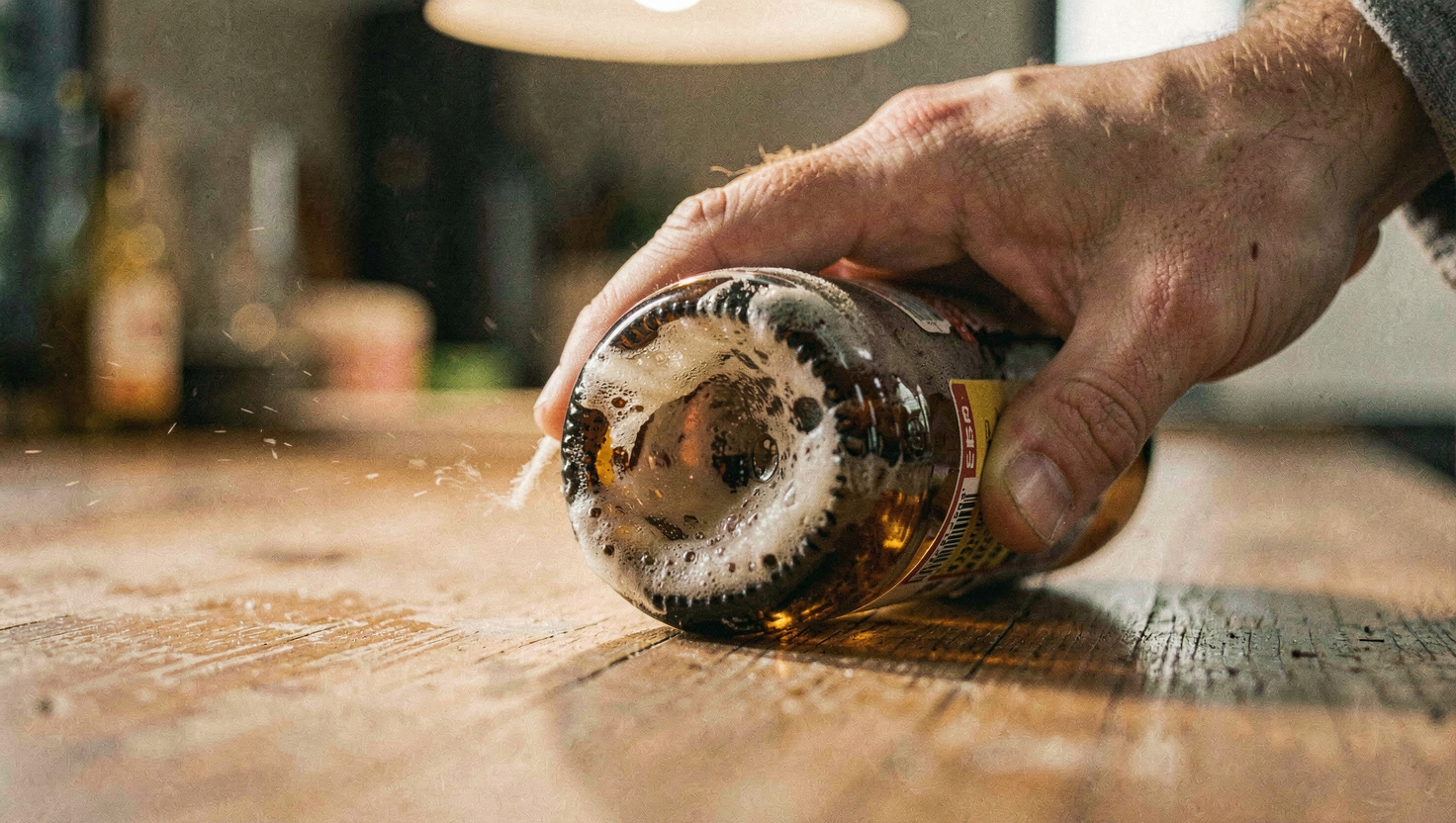
- Stop with two centimetres of beer left in the bottle. Roll the bottle gently on the counter to rouse the yeast sediment.
- Pour the roused last measure into the middle of the glass. The beer goes cloudy, the collar lifts, and that is the finished pour.
Serve it at 7 to 8 degrees. Colder than that and the carbonation stays in solution, the head is thin and the clove note disappears; warmer and it gushes on the way out of the bottle.
The lemon question
A wedge of lemon on the rim is a habit that travelled with a particular style of wheat beer and then stuck to all of them. Citrus oil is fat soluble and surface active, which is a technical way of saying it kills foam on contact. Squeeze a lemon into a weizen and you can watch the collar go down.
If you like it, it is your beer. Just know that you are trading the head and everything the head carries for the citrus, and that the same chemistry is what makes a greasy glass such a problem, as set out in head retention: what the foam is telling you.
What else the shape tells you
Once you can read a weizen glass, the rest of the shelf becomes legible. A stem means the designer wanted your hand off the bowl. A bulge below the rim means the glass was built to be stacked and handled. A straight cone means the glass is doing serving work rather than aroma work. That reading exercise is the whole of pilsner, tulip, nonic: reading a glass by its waist.
One last practical warning. A weizen glass is the hardest ordinary glass in the house to wash properly, because it is deep, narrow at the middle and wide at the top, which means a normal brush cannot reach the waist. Any residue left there shows up immediately as a ring of bubbles clinging to the wall, and the fix is in washing and storing glassware so the head survives. The only glass on the shelf that is worse is a boot, which has a whole article of its own in how to drink from a beer boot without wearing it.
Between the engineered shapes there is room for one vessel made by hand: a handmade mug on the bar shelf.
The shelf under the glassware has its own craft tradition, told in the painted tray under the bottles.
Filed under Glassware. Published August 4, 2026.