Board games that survive a crowded table
A bar table is not a games table. It is smaller, it is wetter, it is louder, and half the people at it arrived after the rules were explained. That rules out most of a games shelf and points clearly at what is left.
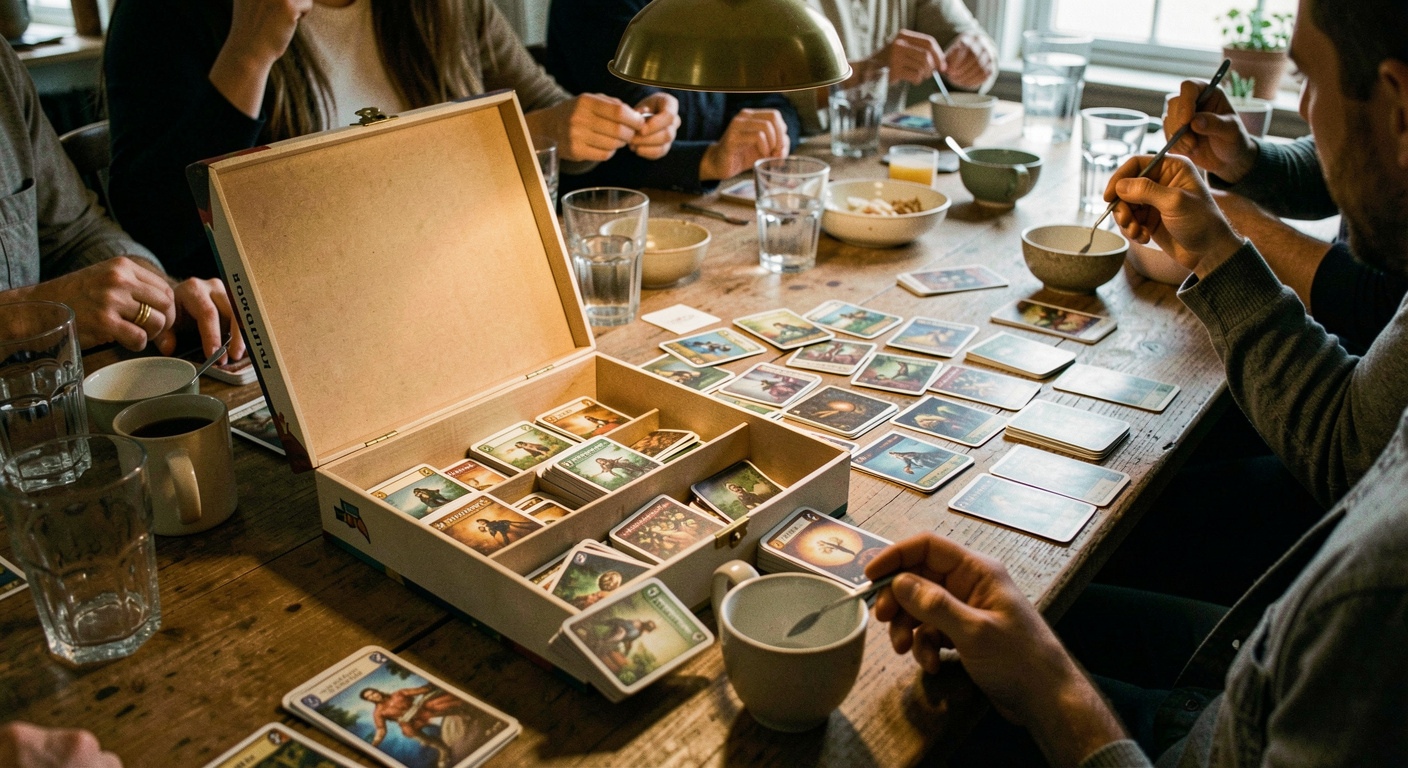
The games that work at a bar table are not the best games. They are the games that tolerate the conditions. Once you write the conditions down, the shelf sorts itself. The same ground is covered in a table with no room left on it.
The six criteria
- Footprint. Can it be played in a 40 by 40 cm square? A bar table is already carrying glasses, bowls, phones and elbows. A game that needs the whole surface is asking the table to stop being a bar.
- Component height. Nothing that stands up. Screens, towers and standing miniatures get knocked over once and then spend the evening being righted.
- Turn length. Under thirty seconds, or simultaneous. A game with two minute turns at a table of eight means fourteen minutes between your goes, and people leave the game without leaving the table.
- Explanation time. Under three minutes, and re explainable in twenty seconds to whoever arrives late. Anything longer and the person explaining stops enjoying their evening.
- Spill tolerance. What happens when a glass goes over. Cards recover if they are plastic or cheap. Printed sheets are disposable and fine. A hand painted wooden component is a bad idea to have on the table at all.
- Player count. Five to eight, and ideally with a rule for adding a player mid game.
What passes
Word and association games played from a card grid. A five by five grid of word cards takes very little space, the turns are short, and the whole thing is explained in a couple of minutes. Two teams, one talking at a time, and everybody at the table is involved even when it is not their go. This is the strongest single category for a crowded table.
Social deduction games with no board at all. A deal of role cards, a discussion, a vote. The footprint is one card per player, face down, and the rest of the game happens in conversation. It scales to large groups better than anything else and it survives noise, because the noise is the game.
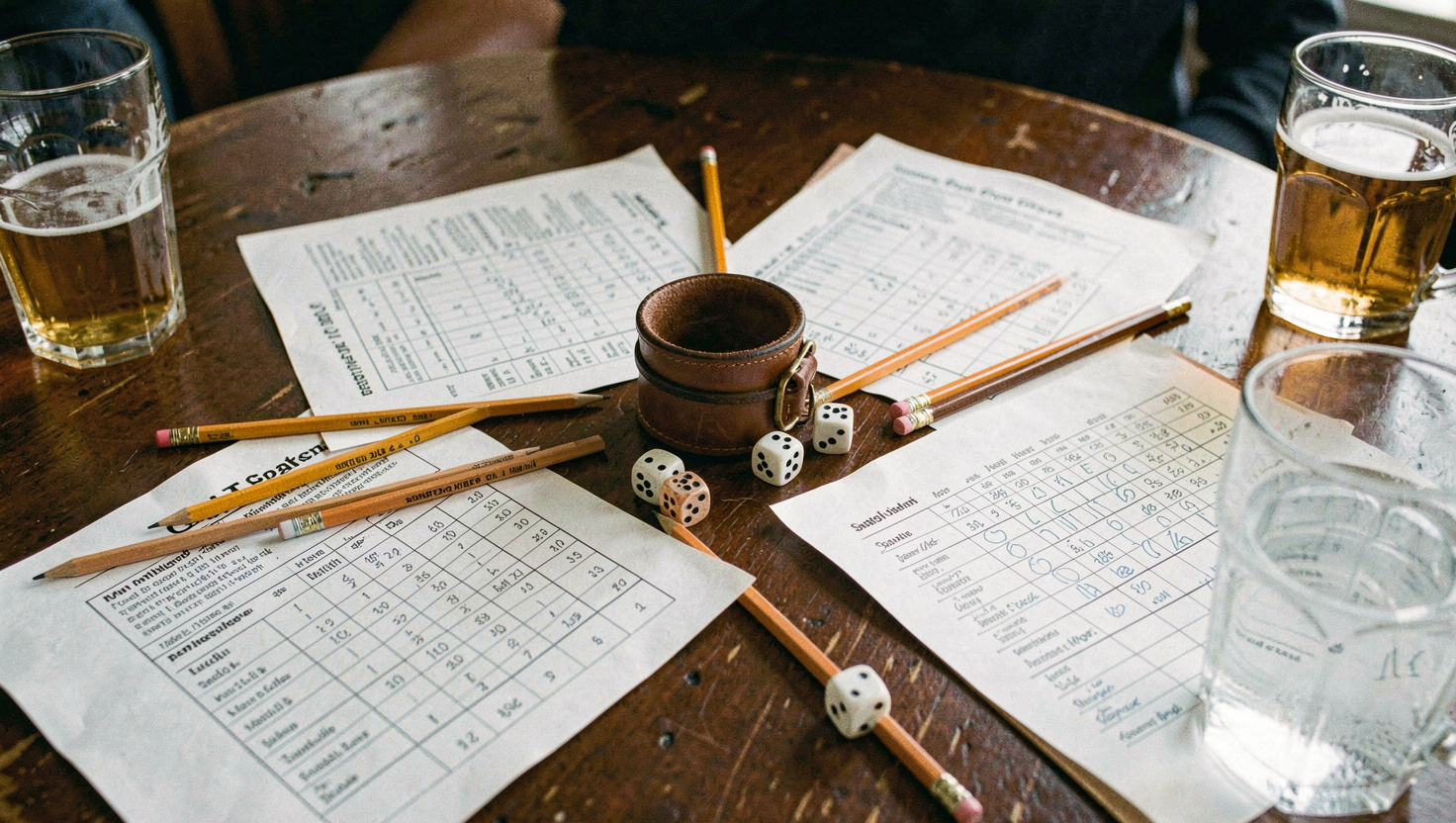
Roll and write games. One printed sheet and a pencil per player, a cup of dice in the middle, and no shared board of any kind. Everybody plays every turn at the same time, so the game runs at the speed of the fastest player rather than the slowest. If a drink goes over, you lose one sheet from a pad of a hundred. For a bar table this is close to the ideal form.
Small card games with a shared discard pile. A trick taking or ladder climbing game needs a hand of cards and one pile in the middle. It is the reason card games have been played in bars for centuries, and it is why the drinking game shelf is dominated by them; the simplest example of the type is High or Low, which needs one card face up at a time and nothing else. If the table wants something with more game in it, the ladder climbing structure in Asshole is a genuine card game that happens to fit in the same amount of space.
What does not pass, and why
- Dexterity games. Flicking, stacking and balancing next to full glasses. The failure mode is obvious and expensive.
- Tile laying games with a growing footprint. They start in a 30 cm square and finish covering a metre. On a bar table the game eventually pushes the drinks off the edge.
- Anything with hidden information behind a screen. Screens fall over, and at a crowded table people are looking over shoulders anyway.
- Long games with elimination. A player knocked out at the forty minute mark of a ninety minute game is a person you invited who is now watching.
- Games with a heavy rulebook. Not because people are incapable, but because a table with drinks on it will not sustain a rules lookup. If you have to open the book after the first ten minutes, the game is over.
The one house rule worth having
Whoever teaches the game makes the ruling, immediately, and the table moves on. Write the ruling on the back of the box if it comes up twice. This is the same convention that keeps card games moving, and it is why the rule sheets on this site put the disputed moments at the end rather than leaving them to the evening.
Storing them so they get played
Throw away the moulded insert. Bag the components with elastic bands or small zip bags and the box halves in size, which means twice as many games fit on the shelf next to the bar, which means the right game is within reach when the moment comes.
Keep the two or three that always work in a drawer at the table itself rather than on a shelf in another room. A game that requires a trip upstairs gets played about a third as often as one that is already in the room.
When to bring one out
Roughly two hours in, when the conversation has fragmented into pairs and the room needs a reason to mix again. That timing is the same one that works for any structured activity at a party, and it is part of the schedule set out in a twelve person night on a six person table.
If the group is up for something longer and more serious, that is a different evening with a different setup, and the practical end of it is in poker night at home: table, chips, and the first hour. And if the table is too crowded even for cards, the honest answer is to move the game off the table entirely, which is what a dartboard is for: see darts at home: height, throw line, wall.
When the boxes stay on the shelf and the table just wants dice and a stake, games of chance at the table.
For the crowd that wants its competition in questions rather than meeples, the pub quiz answer sheet, typed properly.
Filed under Bar games. Published October 9, 2025.